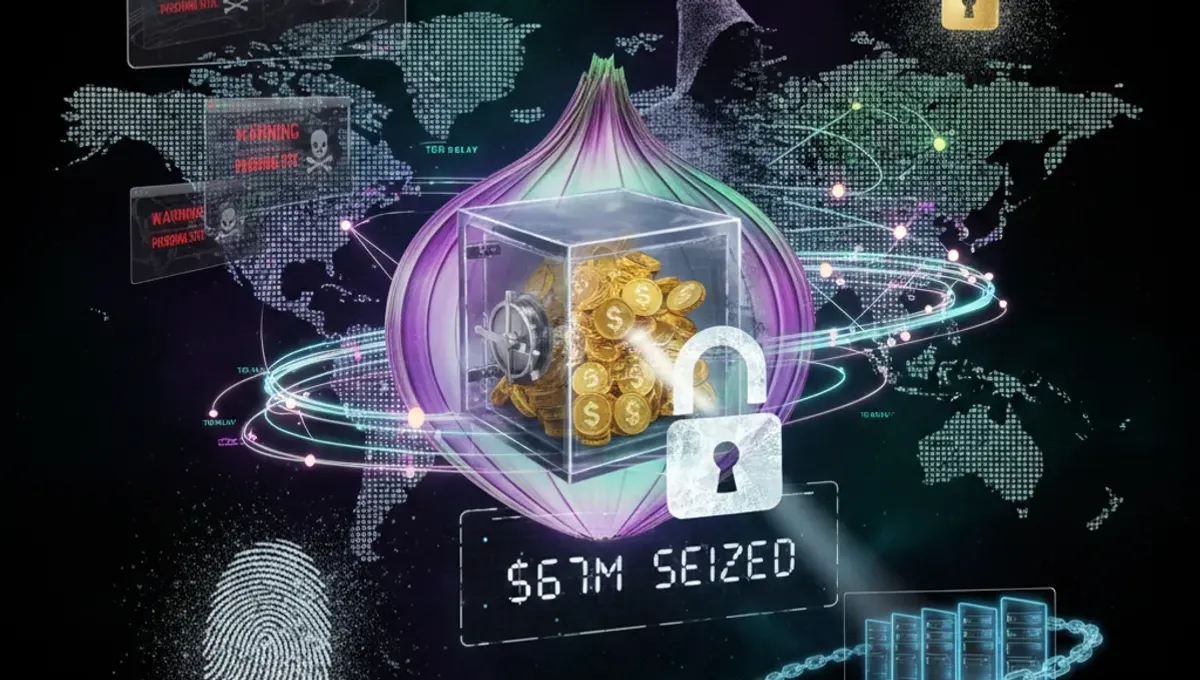
What Happened: The Seizure Timeline
In 2025, the US Department of Justice announced that it was seeking forfeiture of approximately $61.19 million in USDT held across 10 addresses on the Tron blockchain. Tether, the issuer of USDT, had already frozen those funds in response to US government pressure. Prosecutors alleged that the money represented proceeds from the sale of Iranian oil on black markets, a direct violation of US sanctions targeting Iran's petroleum sector. The action combined legal proceedings against the funds themselves (a civil forfeiture case) with Tether's own compliance mechanism, which allows the company to freeze or blacklist addresses at the request of law enforcement.
This seizure was not a surprise technical hack or a market fluctuation. It was a deliberate, coordinated action between a federal agency and a private stablecoin issuer. Tether's ability to freeze funds on addresses it deems problematic is built into the USDT contract itself, a feature that separates stablecoins from decentralized cryptocurrencies like Bitcoin or Ethereum, where no single entity can reverse or freeze transactions once confirmed on the blockchain.
How Stablecoin Freezing Works in Practice
Unlike Bitcoin, where transactions are irreversible once mined into a block, USDT is an ERC-20 token on Ethereum and a TRC-20 token on Tron that operates under centralized governance. Tether maintains a blacklist of addresses it will not allow to send or receive tokens. When a law-enforcement agency or financial regulator submits a legal demand, Tether can add an address to that blacklist, effectively rendering the funds inaccessible to their holder, even though the tokens remain in the blockchain's ledger.
This freeze mechanism exists because stablecoins are designed to maintain a 1:1 peg to the US dollar, and to do that, they must comply with US banking regulations and sanctions law. The Office of Foreign Assets Control (OFAC), which administers US sanctions programs, publishes lists of individuals, entities and addresses suspected of sanctions violations. Stablecoin issuers monitor these lists and must refuse to process transactions involving listed parties.
The practical effect is that a holder of $61 million in USDT on a blacklisted Tron address cannot move, trade, or withdraw that money through any exchange or service that respects Tether's freeze. They could still see the tokens in their wallet, but attempting to spend them would fail. Only Tether or a court order can remove an address from the blacklist, which in a civil forfeiture case may take years.
Why This Matters for Sanctions Enforcement
Cryptocurrency has long been a tool for circumventing sanctions. Traditional banking systems have reporting requirements, account verification, and automated compliance screens. Blockchain addresses, by contrast, are pseudonymous and do not require identity verification to create. This combination made crypto attractive to actors seeking to move sanctioned funds without leaving a conventional paper trail.
The Iranian oil sector is subject to sweeping US and international sanctions designed to pressure the Iranian government and limit its financing of military activities. Despite these restrictions, Iranian oil continues to be sold on black markets, often transported by tankers that disable identification signals and sold to buyers who know or should know the origin. The proceeds need to be moved and stored somewhere. For years, some of those proceeds appeared in crypto, precisely because it seemed less traceable than a bank transfer.
What this seizure demonstrates is that the anonymity advantage is shrinking. Blockchain transactions are permanent and public. Law enforcement has become expert at tracing cryptocurrency flows using chain analysis tools, identifying patterns of behavior, and then requesting issuers or exchanges to freeze or seize funds. When USDT is involved, the issuer has the technical ability to comply immediately, making it a highly effective pressure point.
The Limits of Decentralization in Enforcement
This action also highlights why decentralized stablecoins and cryptocurrency advocates emphasize the importance of truly decentralized systems. USDT can be frozen because Tether is a corporation with a legal seat, banking relationships, and regulatory exposure. If someone held the equivalent value in Bitcoin or Ethereum, no single entity could unilaterally freeze it. The holder would retain access as long as they controlled their private keys.
However, decentralization does not make a sanctioned person wealthy. Once crypto is frozen at the point where it enters the banking system (which Tether eventually must do to maintain its peg), law enforcement can still seize it. The real friction point is the journey from blacklist to actual arrest or asset recovery. Freezing USDT is fast and reversible; it does not require a trial or conviction. A civil forfeiture proceeding can move forward independently of any criminal charges, and the owner must prove that their funds came from a lawful source, which reverses the ordinary burden of proof in criminal law.
Verification and Transparency Questions
When Tether freezes an address, it does not always publish the reason or the legal authority behind it. In this case, the seizure was announced through the Department of Justice, so the public record is clearer than it is in many other instances. However, other freezes occur quietly, and exchanges that receive blacklist updates from Tether may not know or disclose to their users why a deposit or withdrawal suddenly failed.
For users concerned about the risk of frozen funds, several precautions exist:
- Understand that stablecoins like USDT are not censorship-resistant in the way Bitcoin is; they are designed for compliance, not for evading it.
- Verify the source and reputation of any entity receiving funds, especially if they are located in sanctions target countries or sectors.
- Use decentralized stablecoins like DAI or decentralized exchanges if avoiding centralized freezing is a priority, though these trade liquidity and simplicity for that protection.
- Monitor public OFAC lists and Tether's blacklist announcements to understand which addresses are at risk.
Most ordinary users will never encounter a freeze. But for those moving significant value or engaging with counterparties in high-risk jurisdictions, understanding how and why stablecoins can be frozen is essential risk management.
What This Precedent Signals
This seizure is not an isolated case. The US Department of Justice and other agencies have increasingly used stablecoin compliance as a tool for sanctions enforcement, particularly targeting Iran, Russia, North Korea, and other sanctioned regimes. Each successful freeze demonstrates that the mechanism works and that courts will uphold forfeiture orders. It also reinforces Tether's compliance posture, showing regulators that the company is responsive to law-enforcement requests.
For Tether and its competitors, this is a cost of operating within the US financial system. Stablecoin issuers that want banking access, and thus the ability to maintain their pegs, must comply with sanctions law. Any refusal to freeze would likely result in banking relationships being terminated, making the stablecoin economically unviable.
The practical lesson for users and organizations is straightforward: stablecoins are a tool for efficient value transfer, but they are not a tool for moving sanctioned or illegally obtained wealth outside the reach of US law. If that is the intended use, the holder is taking an extreme legal risk. If that is not the intended use, understanding how freezes work and how to verify an address's history provides reassurance and transparency.